
Generations of families have called Georgetown home, their roots running deep into the limestone soil of Williamson County. Among them is Emily, an eighth-generation Georgetownian whose ancestor, Greenleaf Fisk, served as the county’s first judge. Her childhood memories are stitched into the fabric of the town—racing down “jail hill” on her bike, crossing Williams Drive when traffic was sparse, and watching prisoners from the minimum-security jail leave for work during the day and return at night. As a child, Emily lived in the house across from the jail, which is now 309 Coffee. Georgetown has changed, but Emily’s connection to it has remained steadfast.
After high school, Emily followed the familiar path of many young people, leaving town for college. She studied geology at West Texas A&M, became a teacher, and married. In her late twenties, she and her husband returned to Georgetown to be closer to family. But life took a devastating turn: five weeks into her pregnancy, Emily’s husband died. Around the same time, she was diagnosed with a severe autoimmune disease. Suddenly, she was a widowed, single mother navigating disability and grief.
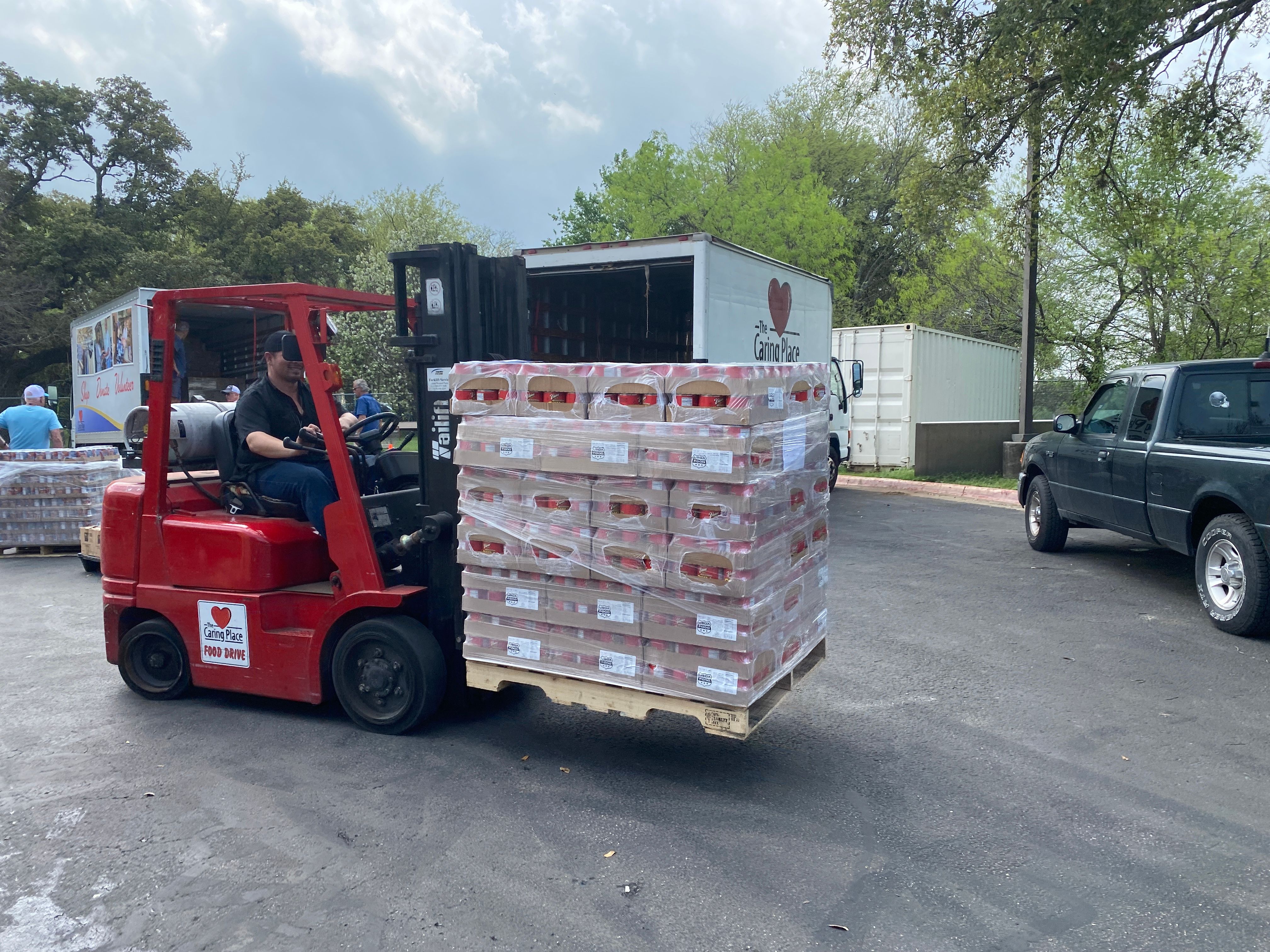
Her condition brought unpredictable health challenges—vision loss, light sensitivity, sensitive skin, and chronic pain. Holding steady employment proved difficult, but Emily found ways to stay engaged. She volunteered at her son’s school, joined the PTA, and later, when her son was grown, began volunteering at The Caring Place, a nonprofit that has long been a lifeline for Georgetown neighbors in need.
For Emily, The Caring Place has been more than a resource—it has been a community. She relies on government programs to help cover medicine and insurance, but shifting policies often leave her scrambling to plan for future expenses. When a medication she depends on is suddenly no longer covered, the stress is immense. In those moments, The Caring Place helps fill the gaps with food. How does food help?
Emily regularly participates in the Fresh Food for Families program, held on the 1st, 3rd, and 5th Monday of each month. Fresh produce is expensive, but essential for her health.
“Starches and flour are the cheap stuff,” she explains, “but vegetables can get very expensive. Coming to The Caring Place means I get to have more nutritious meals and the fresh fruits and vegetables that I might not get otherwise.”
Her Caring Card also gives her access to the Food Pantry once a month, where she plans meals around what’s available and supplements at H-E-B. Hygiene products—like toothpaste, soap, and shampoo—are especially valuable. With her sensitive skin, finding Dove Sensitive Skin body wash at the pantry is more than a convenience; it’s a relief from a significant expense. The Caring Place’s food support offsets other bills for Emily.
Last year, when renewing her Caring Card at The Caring Place, a staff member suggested adding a store voucher. Emily was hesitant, but grateful. “I really did need it, so I was glad she did that,” she recalls. She stretched her budget even further at The Caring Place’s thrift store, where she found a blouse for just fifty cents during a Rummage Sale.
“You just don’t know everyone’s story. No one should be embarrassed. Everyone has a different situation. They could be disabled, a widow, and a single mom. You just don’t know.”
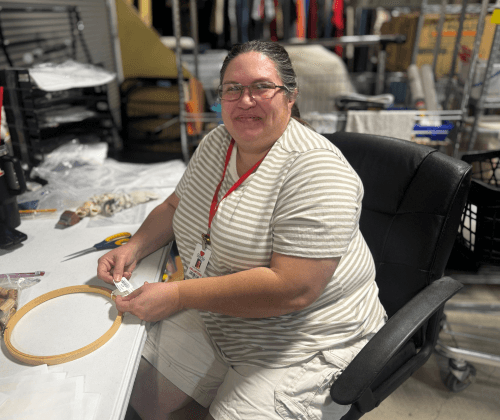
Volunteering has become Emily’s way of giving back. She works in the craft and office supply department, where she sees families and teachers shopping for affordable school supplies year-round. “Families and teachers are coming here to get what they need for their classes at a cheaper price,” she says. “They all have other bills they must pay too, like water and electricity, so I think that affordability helps.”
Though volunteering takes a toll on her body, Emily treasures the experience. “It’s worthwhile and helps other people, and that feels good. You get those feel-good endorphins, and helping people is the important thing.” She also values the friendships she’s built with fellow volunteers. Looking at the sales totals from her department, she feels proud knowing that revenue translates into food for the pantry.
Crafting is another outlet for Emily. Despite her vision loss, she knits, crochets, and experiments with embroidery kits. “I forget I can’t see well sometimes,” she laughs. “I can’t see half of it. I’m just doing the best I can, but it gives me something to do.” Crafting, she says, helps her cope with pain.
Emily believes Georgetown is unique because of The Caring Place’s model—thrift stores funding food pantries and bill assistance. “A lot of places don’t have something like this,” she reflects. “I think The Caring Place can help a lot more people than many other places because of this model.”
Her message to the community is simple but profound: “You just don’t know everyone’s story. No one should be embarrassed. Everyone has a different situation. They could be disabled, a widow, and a single mom. You just don’t know.”